
Sorry, but your login has failed. Please recheck your login information and resubmit. If your subscription has expired, renew here.
March-April 2014
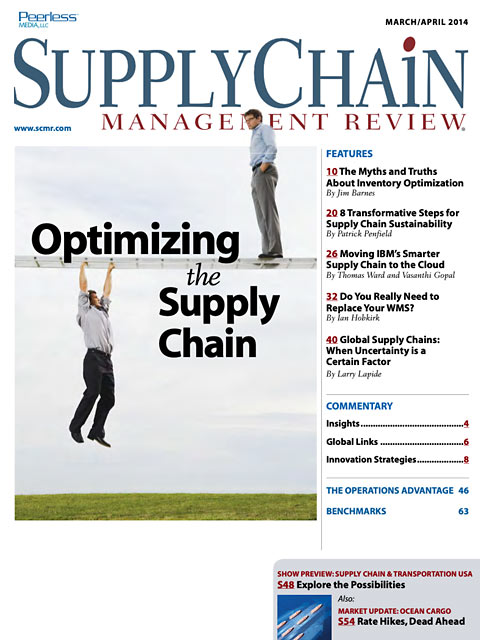
Retailers and distributors alike have attempted to solve their inventory challenges by using forecasting tools to determine what to buy and when to buy it. A better approach is to change the flow of inventory by reducing cycle times, more effective inventory positioning, and synchronizing supply chains based on the variability of demand. Browse this issue archive.Need Help? Contact customer service 1-508-503-1313 More options
During the past eight years, I have studied and helped companies move down the path to supply chain sustainability. The supply chain process for any company transforming to sustainability is one that evolves over time and has to work within the existing corporate operational structure. This transformation is not easy and requires financial justification for many of the proposed sustainability changes.
The biggest obstacle many supply chain leaders face is providing a favorable return on investment (ROI). In today’s world, corporations and organizations are still incentivized with making an organization as profitable and as efficient as possible. This is the basis of corporate success and the rules to which we must adhere in order to change our supply chains. Thankfully, many companies have seen a favorable ROI when working on supply chain sustainability projects. The goal for many supply chain change agents is to prove that sustainability will reduce costs and help the environment. Many companies and organizations are already moving down this path. But how do you do it? What steps should an organization take to transform its supply chain in order to successfully walk the path of supply chain sustainability?
Based on my research at the Whitman School of Management and consultations with organizations, there are a number of supply chain issues business will contend with in the coming years along with eight steps companies can take to successfully walk toward supply chain sustainability.
 |
This complete article is available to subscribers
only. Click on Log In Now at the top of this article for full access. Or, Start your PLUS+ subscription for instant access. |
Not ready to subscribe, but need this article?
Buy the complete article now. Only $20.00. Instant PDF Download.
Access the complete issue of Supply Chain Management Review magazine featuring
this article including every word, chart and table exactly as it appeared in the magazine.
SC
MR
Sorry, but your login has failed. Please recheck your login information and resubmit. If your subscription has expired, renew here.
March-April 2014
Retailers and distributors alike have attempted to solve their inventory challenges by using forecasting tools to determine what to buy and when to buy it. A better approach is to change the flow of inventory by… Browse this issue archive. Access your online digital edition. Download a PDF file of the March-April 2014 issue.|
|
Download Article PDF |
During the past eight years, I have studied and helped companies move down the path to supply chain sustainability. The supply chain process for any company transforming to sustainability is one that evolves over time and has to work within the existing corporate operational structure. This transformation is not easy and requires financial justification for many of the proposed sustainability changes.
The biggest obstacle many supply chain leaders face is providing a favorable return on investment (ROI). In today’s world, corporations and organizations are still incentivized with making an organization as profitable and as efficient as possible. This is the basis of corporate success and the rules to which we must adhere in order to change our supply chains. Thankfully, many companies have seen a favorable ROI when working on supply chain sustainability projects. The goal for many supply chain change agents is to prove that sustainability will reduce costs and help the environment. Many companies and organizations are already moving down this path. But how do you do it? What steps should an organization take to transform its supply chain in order to successfully walk the path of supply chain sustainability?
Based on my research at the Whitman School of Management and consultations with organizations, there are a number of supply chain issues business will contend with in the coming years along with eight steps companies can take to successfully walk toward supply chain sustainability.
|
|
SUBSCRIBERS: Click here to download PDF of the full article. |
SC
MR

Latest Supply Chain News
- Supply chain resilience isn’t a data problem; it’s a judgment problem
- Beyond the hype: Building flexible and scalable supply chains in a VUCA world
- Why your supply chain risk management plan will fail
- When component verification becomes operational
- Caught between a rock and a hard place: Mapping your supply chain
- More News
Latest Resources
 Explore
Latest Supply Chain News
- Why your supply chain risk management plan will fail
- When component verification becomes operational
- Caught between a rock and a hard place: Mapping your supply chain
- What options do you really have? Shaping the supply chain resilience funnel
- Nexus suppliers: Hidden anchors of resilience in decentralized supply chains
- Developing the next generation of supply chain leaders: Is higher education serving the needs of the marketplace?
- More latest news
Latest Resources
Subscribe

Supply Chain Management Review delivers the best industry content.

Editors’ Picks



